Have The Answer Ready, Out Loud, By Tonight
Ten minutes a day on the twelve questions people actually ask. It picks the cards. You just turn up.
It is a tool, not a book. Open it tonight and you will say one of the twelve out loud, in your own words, without reading it. Thirty days is how long it takes to still have it in June.
Instant access. Nothing recurring, ever. 14-day guarantee.
66 cards · 12 questions · 10 minutes a day · A named source on every single answer
Opens in your browser on your phone or your laptop. Nothing to install, nothing to print, no app store.
Product facts, not results claims. Every one is checkable inside the tool.
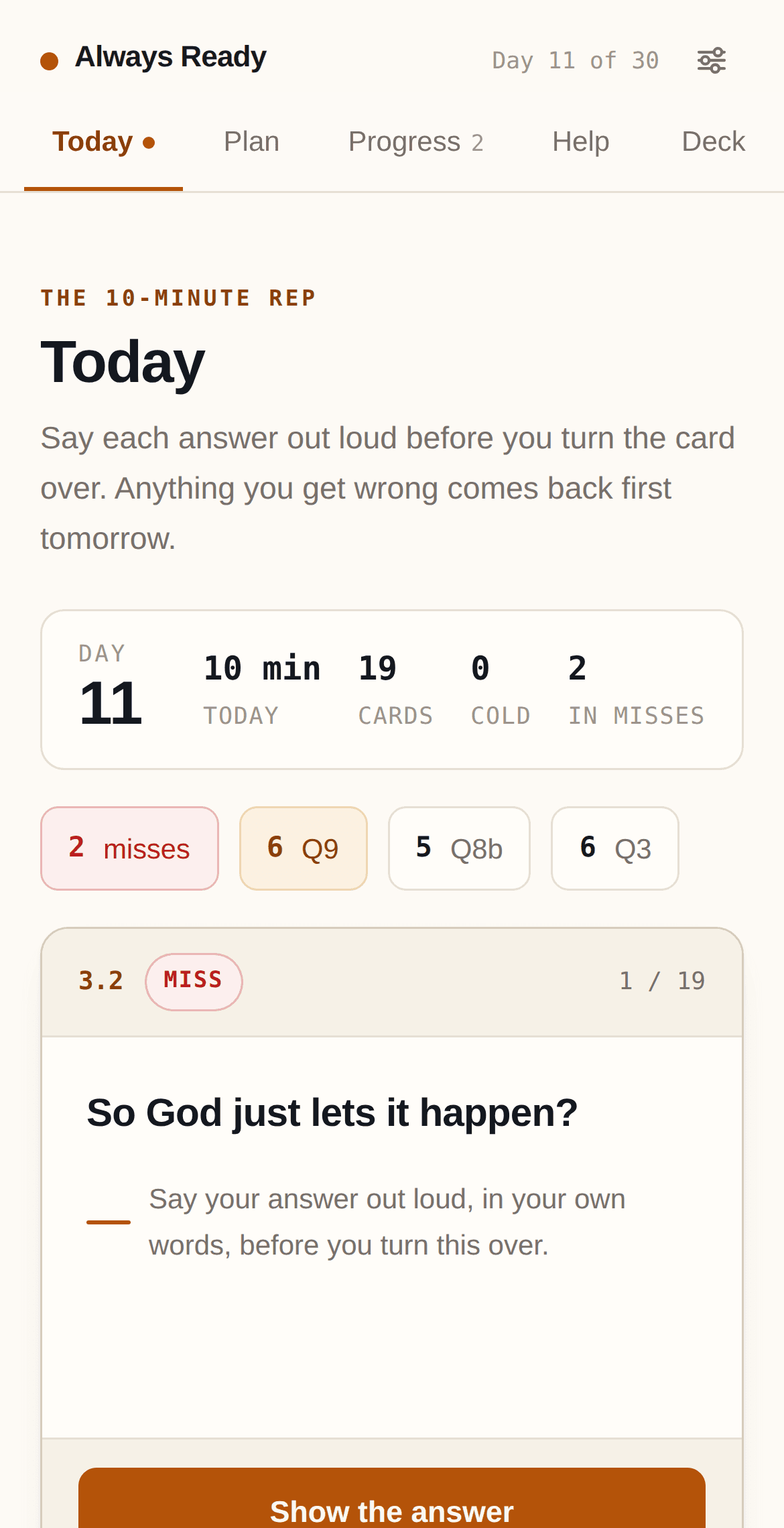
This is the product. Day eleven, mid-drill, on a phone. It has already worked out what you are doing today: two cards you got wrong yesterday, then the new question, then two blocks of review. You did not plan any of that and you are not going to.
A real screen from the tool, not a mockup.
The Real Opportunity
Here’s How Ordinary Christians Turn Ten Minutes A Day Into Answers That Are Still There Six Months Later
You did the studies. The books, the videos, the podcast in the car.
You understood every word of it on the day.
Then your brother in law says something across the dinner table six weeks later, and there is nothing there. You know you know it. You cannot get it out.
That is not a faith problem. It is a memory problem, and it has a fix.
Here is the part nobody tells you. Reading it again will not help. Reading feels productive and does almost nothing, because recognising an answer and producing an answer are two completely different skills. You have been practising the wrong one.
You do not need more Bible study.
You need to keep the one you did last month.
Which is why this is not another thing to read. It is a tool you open. It asks you a question and waits, you answer out loud, and it decides what comes back and when. There is nothing to study, nothing to print off, and nothing for you to organise.
What Happens In The Next Ten Minutes
Not in thirty days. Tonight.
You open it. It gives you the first question people actually ask: how do you know God is real. Six cards, one at a time.
Each one asks you something and then waits. You say your answer out loud, in your own words, before anything is revealed. It will feel slow and slightly stupid. That feeling is the mechanism.
Ten minutes later you close it, and you have said something out loud that you could not have said when you sat down.
That is day one. It is four minutes of cards and it is deliberately almost nothing, because the hardest day is the first one.
Then it tells you when to come back.
Instant access. Nothing recurring, ever. 14-day guarantee.
Why Thirty Days, And Not Three
Because the spacing is the product.
Spaced repetition and active recall: what medical students use to hold ten thousand facts and language learners use to hold a vocabulary. It has never been pointed at Bible study, and there is no reason for that other than nobody bothered.
You meet each question again the next day, then a week later, then a fortnight later, each time at the moment it is about to fade. Take those gaps out and you do not get a faster product, you get one that does not work.
Around day four you will get cards wrong that you were sure you knew. That is the system working. Forgetting something and hauling it back is the entire mechanism. It is also the day most people quit, which is why the tool warns you before you start rather than after.
What is new is that you are not the one running it.
This used to be a stack of files and a printed schedule, and you had to be your own drill sergeant. It is now a tool that opens on your phone and does the deciding:
- It builds today’s session. Misses first, then new cards, then review. You never choose and you never plan.
- A card you get wrong today comes back first thing tomorrow. Not four cards later. Not next week. You track nothing.
- Short on time? One button. Five minutes only drops the oldest review block and keeps the cards you actually need.
- From day 16 it takes the cards away. You say the whole question cold, out loud, then check.
- On day 29 it reads your own miss log and picks the three questions you get wrong most. Those are the ones you drill.
- On day 30 you hand your phone to somebody else and they pick any three they like. You do not choose and you do not see them first.
And it turns up. Pick when you will do it, and it emails you at that hour, in your timezone, skipping any day you have already drilled and stopping itself for good at day thirty.
Nothing to schedule. Nothing to print. Nothing to remember.
I Have No Testimonials And I Am Not Going To Fake You Any
This went live this month. Nobody has finished thirty days yet, because thirty days have not passed.
So I am not going to show you a wall of smiling strangers who supposedly transformed their lives. You have seen those. You know what they are worth.
Here is what I will show you instead: the tool argues against itself in public.
Open card 2.2 and it hands you the strongest objection to its own argument, using Bart Ehrman’s own number, and tells you to raise it yourself before the other person does.
Open card 12.3 and it refuses to tell you that the apostles were offered the chance to take it back, because no source actually records that, and I would rather be careful than impressive.
Open card 1.4 and it will not let you claim that physicists accepting fine tuning means physicists believe in God. The observation is science, the conclusion is philosophy, and it will not blur them for you.
If you have ever repeated something confidently and had it fall apart in front of you, you already know why that matters more than a testimonial.
When people have finished and told me how it went, their words will go here, in their own words, good and bad. Until then this space stays honest and empty.
What You Get For £27
Always Ready: The 12 Questions · £27
The 12 Questions: How do you know God is real · How do you know the Bible is reliable · Why does God allow suffering · Wasn’t Jesus just a good teacher · How can there be only one way · What about people who never heard · Isn’t the Bible anti-women · What about science and evolution · What about the contradictions · Isn’t faith just believing with no evidence · What about all the harm done by the church · How do you know Jesus rose from the dead
Instant access. Nothing recurring, ever. 14-day guarantee.
It Will Also Tell You To Close It
There is a route in the tool that ends with the instruction to shut the whole thing down.
If the person in front of you is not arguing, if something has happened to them and they are asking why, the tool says this:
Close this. Do not run the deck.
Say you are sorry. Say you do not know why. Stay.
An argument aimed at a hurting person is a wrong answer even when every word of it is right.
That is in the product on purpose. Job’s friends sat with him for seven days and said nothing, which is the only part of that story they got right.
Knowing when not to answer is part of being ready.
The 14-Day Cold Test
Run it for fourteen days.
If you cannot answer three of the twelve questions cold, with no notes and no phone, email me and you get every penny back.
You do not have to prove anything to me. You do not have to send me anything. You email me and I refund you.
Two weeks is not a trial. It is long enough to have been through day four, which is the day it gets hard and the day most people quit, and to have come out the other side.
Three Things People Ask
“Thirty days sounds like a lot.”
The commitment is ten minutes. Day one is four. You get your first answer out loud tonight, and the thirty days are what stop you losing it again by Christmas. If it is not doing something for you inside two weeks, you get your money back.
“Is this a subscription?”
No. You pay £27 once. There is no plan, no renewal, no trial that turns into something. The only recurring thing in the entire product is the daily reminder email, and it stops itself at day thirty.
“What if I miss a few days?”
You pick up on today’s date. You do not double up and you do not go back. The schedule is built to survive gaps, because everybody has them, and anything you got wrong is still sitting in your misses waiting for you. The only way to fail is to never open it.
Tonight, Then Thirty Days From Now
Tonight you say one of them out loud for the first time.
Thirty days from now somebody asks you why, at a table, with no warning, and you just answer it. Not read it. Not agree with it. Say it.
Instant access. Nothing recurring, ever. 14-day guarantee.
Questions? hello@alwaysready.church